
Published 2026-09-30
Keywords
- Ethiopian Orthodox Täwaḥǝdo Church (EOTC),
- Council of Nicaea,
- Kǝbrä Nägäśt,
- Kebra Nagast,
- christology
- Nicene orthodoxy,
- indigenous incarnational theology,
- Tawahedo,
- Täwahedo,
- Tewahedo ...More
How to Cite
Abstract
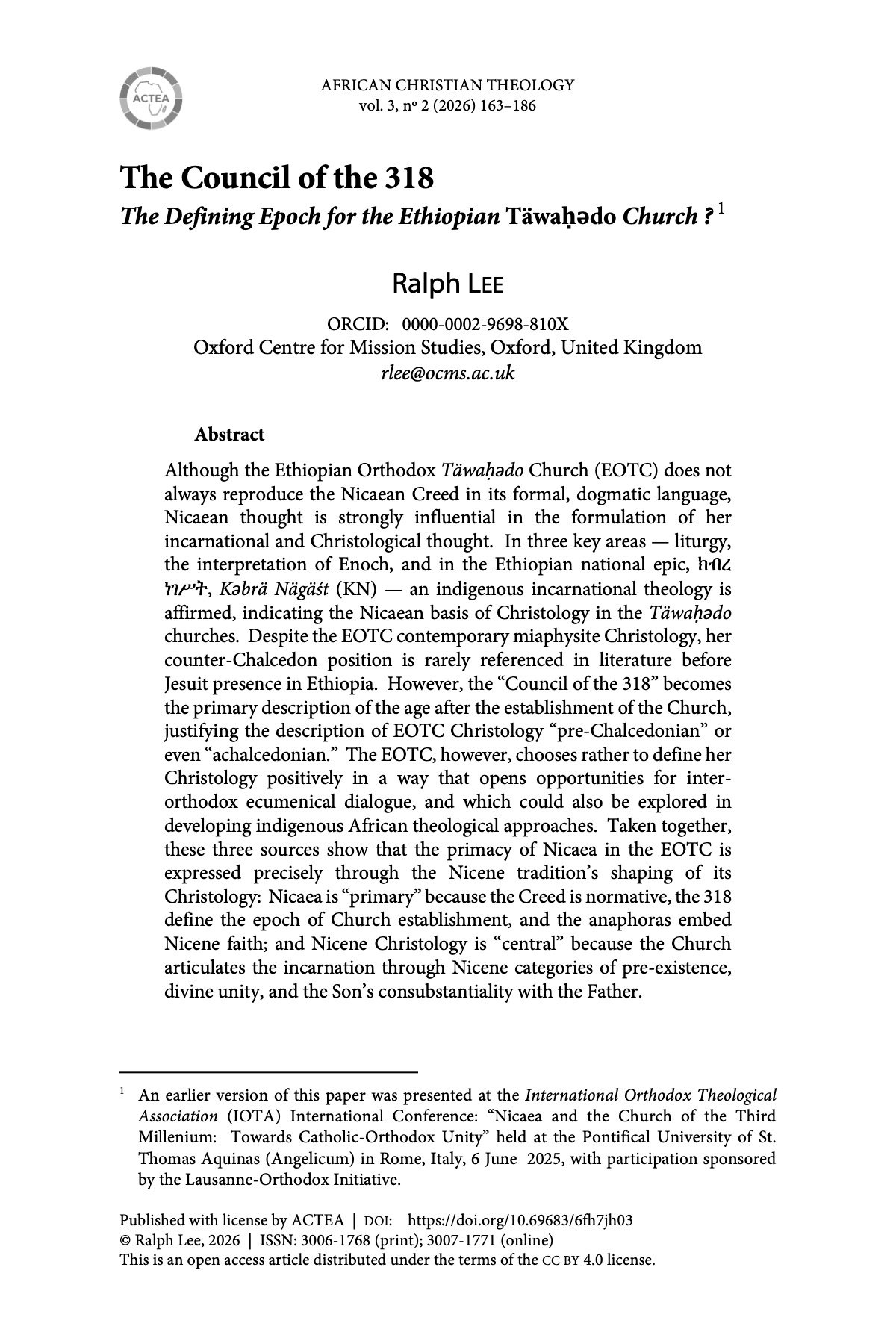
Although the Ethiopian Orthodox Täwaḥǝdo Church (EOTC) does not always reproduce the Nicaean Creed in its formal, dogmatic language, Nicaean thought is strongly influential in the formulation of her incarnational and Christological thought. In three key areas — liturgy, the interpretation of Enoch, and in the Ethiopian national epic, ክብረ ነገሥት, Kǝbrä Nägäśt (KN) — an indigenous incarnational theology is affirmed, indicating the Nicaean basis of Christology in the Täwaḥǝdo churches. Despite the EOTC contemporary miaphysite Christology, her counter-Chalcedon position is rarely referenced in literature before Jesuit presence in Ethiopia. However, the “Council of the 318” becomes the primary description of the age after the establishment of the Church, justifying the description of EOTC Christology “pre-Chalcedonian” or even “achalcedonian.” The EOTC, however, chooses rather to define her Christology positively in a way that opens opportunities for inter-orthodox ecumenical dialogue, and which could also be explored in developing indigenous African theological approaches. Taken together, these three sources show that the primacy of Nicaea in the EOTC is expressed precisely through the Nicene tradition’s shaping of its Christology: Nicaea is “primary” because the Creed is normative, the 318 define the epoch of Church establishment, and the anaphoras embed Nicene faith; and Nicene Christology is “central” because the Church articulates the incarnation through Nicene categories of pre-existence, divine unity, and the Son’s consubstantiality with the Father.